



Updated: Sep 21
Bangkok has a way of announcing itself the moment you step off the plane — the heat presses in like a hand on the back of the neck, the air smells of lemongrass and exhaust, and somewhere a tuk-tuk horn is already insisting you hurry.
You can see this glittering Asian metropolis that often seems to be bursting at the seams as a thing to be endured or you can see it as an overture — loud, fragrant, and generous — to the calm that awaits in the Land of the Thunder Dragon.
A day or two here, spent well, does not compete with Bhutan's stillness. It deepens the arrival. Here are ten ways to spend a Bangkok layover as though it is the point and not the pause.

1. Pedal into the Lungs of Bangkok
Cross the Chao Phraya River, Bangkok's liquid artery, on a five-minute ferry from Khlong Toei and the din of the city simply stops. Bang Krachao — an artificial island formed by a horseshoe bend in the river, protected by royal decree from commercial development — unfurls into sixteen square kilometers of coconut groves, elevated boardwalks, and a nature park with a bird-watching tower rising above the canopy.
Rent a bicycle for the equivalent of a couple of dollars near Bang Krachao pier and simply go where the narrow lanes lead: past stilted homes, small workshops, and roadside noodle stalls where no one is in a hurry. It is, improbably, still Bangkok — just the version the guidebooks forget to mention, ten minutes, and a world away, from the city's overcrowded BTS Skytrains.

How to arrange the experience:
Bang Krachao bike ride | Take Me Tour (Bangkok Tour company can arrange private guided bike rides or you can get to the pier yourself and self-arrange the bike rental at the bike rental shop there.) |
Booking Direct: Trusted Contacts for Each Stop
Wherever a direct establishment takes its own bookings, we favor that over a third-party ticketing platform. Details below are current as of this writing; please reconfirm before departure, as hours and contacts do shift.
2. Queue for Jay Fai
In Old Bangkok's Phra Nakhon district, on a modest corner near Khao San Road, an octogenarian in ski goggles still cooks over roaring charcoal woks (see cover image above) with her own hands — goggles to guard against the spitting oil, not for show.
Khun Jay Fai (the name means something like “Auntie Mole,” due to the large mole on her right cheek) became, in 2018, the first street-food vendor in the world to be awarded a Michelin star, for a crab omelette so laden with fresh lump crab that it arrives at the table the size and heft of a football, crisp at the edges and molten within.
There is no reservation system and there is always a line; come hungry and patient, and consider it a small pilgrimage. Jay Fai is featured in Season 1, Episode 1: “Bangkok, Thailand” of Street Food: Asia (about 30 minutes).
Left: Khun Jay Fai. Right: Jay Fai's signature dish is a giant crispy, savory, omelette oozing with fresh chunks of crab meat.
How to arrange the experience:
Jay Fai | Raan Jay Fai, 327 Maha Chai Rd, Phra Nakhon | No reservations taken. Walk in and queue; check @jayfaibangkok on Instagram beforehand to confirm she's open that day. |
3. Sit Down at Le Du
At the opposite end of the dining experience from the open flame, open kitchen, unrestrained street-food ardor of Raan Jay Fai is the elegant and refined Le Du.
Early on in a meal at Le Du, the significance of the restaurant's name dawns on you. Du is the Thai word for season, and the kitchen here does not so much follow that idea as insist on it: the menu changes with what the country's farmers, fishermen, and rice paddies are actually producing, which means the dish that arrives on a Tuesday in April may not exist by June. This is, on its face, a fine-dining conceit. In the hands of Chef Thitid "Ton" Tassanakajohn, it's more like a thesis.
Mr. Tassanakajohn trained at the Culinary Institute of America and cooked his way through the kitchens of Eleven Madison Park and Jean-Georges before returning to Bangkok in 2013 to open a forty-seat room on a quiet lane off Silom Road. The room has since been rebuilt around a ceiling embedded with some twenty thousand glass test tubes — a detail that could easily tip into gimmick, and does not, mostly because nobody at the table is looking up for long. The food does not permit distraction.
The signature khao khluk kapi arrives as a butterflied river prawn fresh from the Tapi, the longest river in sourthern Thailand, grilled hard at the edges and sweet within, set beside a rice tossed with shrimp paste and two varietals grown in the north; it reads, on the plate, like a study of a single Thai home-cooked dish taken apart and rebuilt with the patience of a research fellow. The khao chae, a royal dish traditionally served over shaved ice in the hot season, turns up here reworked with a restraint that lets the original idea — rice steeped in flowers, condiments arranged like a puzzle around it — stay legible even as the technique underneath it has clearly been rethought from scratch.
What's easy to miss, amid the citations — a Michelin star since 2019, the No. 1 ranking on Asia's 50 Best in 2023, a continued berth on the World's 50 Best list — is how unfussy the room actually feels to sit in. Service explains without lecturing. Nothing arrives faster than the story behind it warrants. It is possible to read Le Du as a monument to Thai culinary nationalism, correcting a Western tendency to flatten Thai food into pad thai and green curry; it is also, more simply, one of the best-cooked tasting menus in Southeast Asia, seasonal in the way that phrase is supposed to mean before it becomes marketing copy. Reservations do not come easily — dinner seats are known to vanish before lunch service does — which is, in its own way, the highest compliment a dining room in this city can currently claim.
The popular local seabass with seasonal water chestnuts, pomegranate and spicy cilantro at Bangkok's Le Du.
How to arrange the experience:
Le Du | Le Du, direct | ledubkk.com · +66 92 919 9969. Book as far ahead as possible — dinner seatings are known to fill before lunch does. |
4. Bike like a Local, with Co van Kessel
Thirty years ago a Dutchman named Co van Kessel began pedaling curious visitors through Bangkok's back alleys, and the tours he started have scarcely changed in spirit since.
The classic route threads Chinatown's narrow sois and temple courtyards before the bicycles are loaded, riders and all, onto a longtail boat that crosses into Thonburi's old canal network — the “Venice of the East,” where stilted wooden houses still lean over the water much as they did a century ago. Longer itineraries continue on to the green plantations across the river, with lunch served, by design, at a local family's home rather than a restaurant built for tourists. It is Bangkok stripped of its highway noise, seen the way a neighbor would show a friend around.

Video: Biking with Co Van Kessel's signature taxicab yellow bikes past classic Bangkok street scenes.
How to arrange the experience:
Co van Kessel Bangkok Tours | covankessel.com — book directly online, or call ahead to confirm the tour and meeting office. |
5. Food Tour After Dark
When the sun drops, Chinatown's Yaowarat Road switches on — neon signs, sizzling woks, and more than two hundred stalls that have fed this two-hundred-year-old trading district for generations. A guided night walk here is less a meal than a procession: char siu pork glossy off the spit, oyster omelettes crackling on flat-top griddles, braised goose noodles, herbal teas poured from dented kettles, and, always, a plate of mango sticky rice to close things out. Wander with a local guide who knows which unmarked doorway hides the best bowl on the block, and Chinatown reveals itself less as a sight to photograph than a neighborhood mid-meal, generously willing to let you join in.

How to arrange the experience:
Night food tour | Chili Paste Tours (guide Chin Chongtong) | chilipastetour.com — small, private, guide-led tours; contact directly to arrange a date. |
6. Watch the Day's Fading Lights Caress Wat Arun
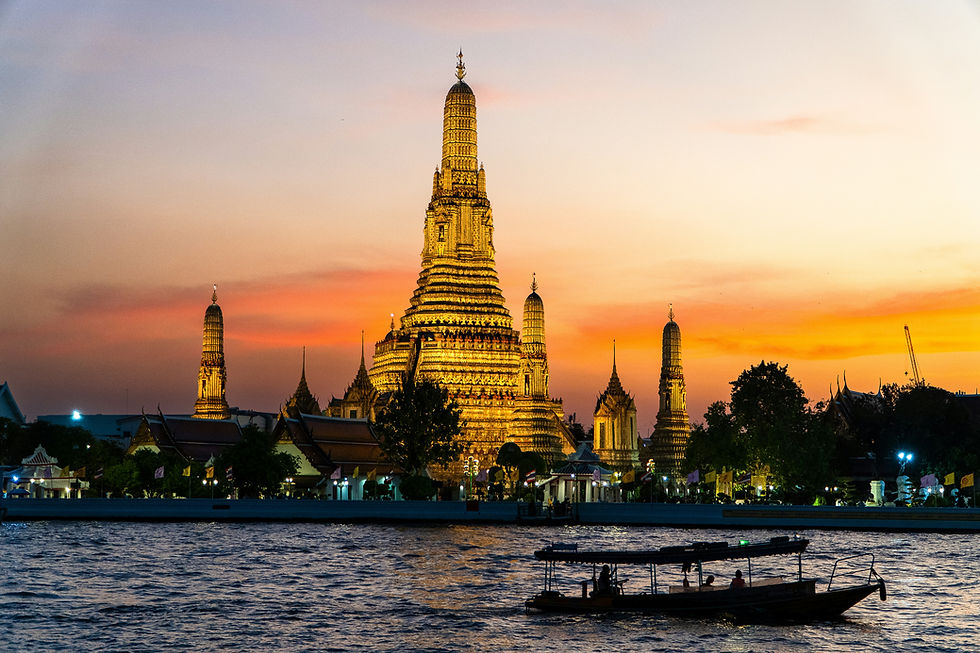
King Taksin named it Wat Chaeng — the Temple of Dawn — after arriving at its riverbank shrine at daybreak in 1767, fleeing a fallen Ayutthaya. Its towering central prang, later raised through the reigns of two kings and clad entirely in fragments of Chinese porcelain, was built to catch the morning sun. But locals know its truest hour is the opposite one: cross to the east bank near Tha Tien pier as evening settles, take a seat at a riverside rooftop, or a nearby park bench and watch the spire go from gold to rose to silhouette against a darkening sky, the Chao Phraya carrying long-tail boats and the last commuter ferries beneath it. It is one of Bangkok's oldest sacred sites, and one of its most quietly moving — a bittersweet feeling to contemplate life, the passing moments flowing like the river, as the fading hues of the day softly caresses, and finally takes leave of Bangkok's most iconic monument.
How to arrange the experience:
Wat Arun sunset | No vendor needed | Self-guided. Open daily, roughly 8:30am–5:30pm; cross via the Tha Tien Pier ferry. |
7. Get Lost Among a Million Blooms
Pak Khlong Talat began, in the reign of King Rama I, as a floating market where boats traded fish and produce along the canal mouth for which it is named. Today it runs on flowers, around the clock, ranked among the largest fresh-flower markets on earth: mountains of marigolds destined for temple offerings, roses sold thirty to a bundle, jasmine garlands strung by hand with a speed that borders on sleight of hand. The market's true pulse comes alive between three and four in the morning, when trucks arrive from Chiang Mai and beyond and wholesalers descend on the narrow aisles — though any hour rewards exploration, the air thick with the mingled scent of orchid and river humidity, color piled on color in a city that rarely sits still long enough to smell like this.

Pak Khlong Talat flower market | No vendor needed. Find it on Google Map | Self-guided. Open 24 hours, free entry. |
8. The Birthplace of Thai Massage
Long before Bangkok existed as a capital, a monastery stood on this ground; King Rama III later had more than a thousand stone inscriptions and carved yogi statues set into its walls, an open-air textbook meant to preserve a healing art then at risk of being lost. That art was traditional Thai massage, and Wat Pho remains its spiritual home — a discipline built on acupressure, deep compression, and assisted stretching rooted in the same Buddhist philosophy that shapes traditional Bhutanese medicine. Pay respects first to the resplendent 46-meter Reclining Buddha, gilded and serene, its soles inlaid with mother-of-pearl; then walk to the massage pavilions at the rear of the grounds, where practitioners trained in a tradition older than the temple itself will press two millennia of accumulated wisdom directly onto tired shoulders. Be warned, though. This is no gentle wellness spa, full of windchimes and piped-in nature sounds. The massage is honest, full-contact human, and can be vigorous to the point of being rough, but well worth the experience, and the story you can tell afterwards!

How to arrange the experience:
Wat Pho massage | Wat Pho Thai Traditional Massage School | watpomassage.com — book ahead for a guaranteed slot, or walk in at the temple's massage pavilions. |
9. Dine Where the Warehouses Once Traded Silk
The waterfront warehouses at Asiatique once belonged to the East Asiatic Company, a Danish trading house that moved freight up and down the Chao Phraya during the reign of King Rama V. More than a century on, those same brick-and-timber buildings have been reborn as a riverside promenade of boutiques, food stalls, and restaurants strung with lantern light — an unlikely but effective setting for romance. Reserve a table on the open-air waterfront terrace as the evening ferries glide past, or, for something more theatrical, dine on the deck of the Sirimahannop, a full-scale replica of a nineteenth-century three-masted trading ship permanently anchored at the pier. Either way, the Chao Phraya does most of the work: dark water, passing lights, and the particular hush that settles over a city river after dark.

How to arrange the experience:
Asiatique riverside dinner (Sirimahannop) | Sirimahannop, direct | sirimahannop.com · +66 2 059 5999 · |
10. The Madness of Chatuchak
Born in the 1940s as a modest flea market and relocated more than once before settling into its current 35-acre sprawl, Chatuchak has grown into the largest weekend market on the planet: roughly fifteen thousand stalls, arranged into twenty-seven loosely organized sections, drawing something like two hundred thousand people through its alleys each Saturday and Sunday. Vintage denim gives way to handwoven textiles, which give way to ceramics, which give way to a courtyard of stray cats and cold coconuts. There is no efficient way to see it and no real need to try — a paper map from the information booth is a suggestion more than a plan. Go with the goal of getting completely turned around, and let whatever finds you be the day's souvenir. Warning: this is one of Asia's craziest and most crowded markets. It's always in your face. Stay away if you're in the mood for peace and quiet.
How to arrange the experience:
Chatuchak Weekend Market | No vendor needed. Find it on Google Maps. | Self-guided. Open Saturday–Sunday, roughly 9am–6pm. Any taxi driver in Bangkok can take you there. Or ride the BTS skytain to the end of the line toward Chatuchak. |


Comments